
The Role of Recycled Synthetic Fibres in Circular Construction
Construction has traditionally worked a little like a one-way conveyor belt, with raw materials coming in at one end, buildings and infrastructure coming out the
eMesh is 100% recycled macro synthetic fibres made from recycled plastic. An Australian innovation, eMesh completely replaces virgin macro synthetic fibres or steel reinforcing mesh to deliver innovative reinforced concrete.
Using 100% recycled MSF is up to 90% reduction in CO2 compared to steel mesh. Representing the next generation of innovation for standard virgin plastic fibres in concrete, eMesh is a more sustainable, cost-effective, easier and safer to use alternative to the conventional concrete reinforcements.
In 2013 we undertook a full cycle research and development program with James Cook University to develop a unique recycled macro synthetic fibre. After a successful trial in 2015, eMesh was introduced to the Australian infrastructure projects. In the same year, eMesh won the Australian Innovation Challenge Award in the manufacture & infrastructure category. eMesh is now widely used as a sustainable alternative to steel mesh and steel fibres in concrete construction in infrastructure projects across Australia.
As the original product born from full-cycle university research and successfully trialled in infrastructure applications in 2015, eMesh stands apart with a Life Cycle Assessment (LCA), an up-to-date Australian third-party audited Environmental Product Declaration (EPD), and approved for use in major projects across the Australian landscape.
focused on the use of recycled plastic in fibre-reinforced concrete. The collaboration successfully delivered technical proof-of-concept trials using small batches of the recycled product, with in-situ testing validating the material’s performance.
after a successful trial in a 100 meter long concrete footpath at JCU, eMesh fibres were used in footpaths and walkways around the JCU’s $80M Science Place Building precinct.
(Manufacturing, Construction and Infrastructure category) for the project on “Development of recycled plastic fibre to reinforce concrete”.
eMesh LCA independently verified and third-party audited.
in 2018 to construct a 1500m2 of concrete shared use path (SUP) without using steel mesh.
in major projects by various infrastructure authorities across Australia.
eMesh LCA independently verified and third-party audited for the 2nd time.
including many large and mega projects across the Australian infrastructure landscape. It has helped reduce the carbon footprint and cost of concrete construction, while contributing to sustainability goals and making construction faster, safer, and easier.
The use of 100% recycled synthetic eMesh fibres, allows local councils to specify and purchase sustainable and environmentally beneficial solutions for their footpaths, cycleways and shared user paths.
focused on the use of recycled plastic in fibre-reinforced concrete. The collaboration successfully delivered technical proof-of-concept trials using small batches of the recycled product, with in-situ testing validating the material’s performance.
after a successful trial in a 100 meter long concrete footpath at JCU, eMesh fibres were used in footpaths and walkways around the JCU’s $80M Science Place Building precinct.
(Manufacturing, Construction and Infrastructure category) for the project on “Development of recycled plastic fibre to reinforce concrete”.
eMesh LCA independently verified and third-party audited.
in 2018 to construct a 1500m2 of concrete shared use path (SUP) without using steel mesh.
in major projects by various infrastructure authorities across Australia.
eMesh LCA independently verified and third-party audited for the 2nd time.
focused on the use of recycled plastic in fibre-reinforced concrete. The collaboration successfully delivered technical proof-of-concept trials using small batches of the recycled product, with in-situ testing validating the material’s performance.
The use of 100% recycled synthetic eMesh fibres, allows local councils to specify and purchase sustainable and environmentally beneficial solutions for their footpaths, cycleways and shared user paths.
Please note that Enviromesh®, eMesh®, and Fibrecon® are fully owned brands. In Australia, our fibres are sold exclusively through Enviromesh. We also have an extensive network of exclusive distributors outside Australia. Please contact our sales team to place an order.
eMesh has been used in several projects around Australia.
So in addition to the benefits of MSF reinforced concrete, eMesh promotes sustainability while delivering environmental and social benefits without adding cost to the construction and infrastructure projects.
The green credentials of eMesh have been tested by researchers, reporting up to 90% saving on CO2 emissions and reduced fossil fuel usage compared to traditional steel mesh reinforcing. The scientific findings behind the eMesh claims have been peer-reviewed by the prestigious Journal of Cleaner Production. eMesh has a third-party audited Environmental Product Declaration (EPD).
When using eMesh, councils can claim green ratings and private companies can boost carbon ratings, without additional costs. The environmental assessment conducted as part a PhD study confirmed the environmental benefits of using eMesh over SL72 mesh, such as savings on CO2 emissions.
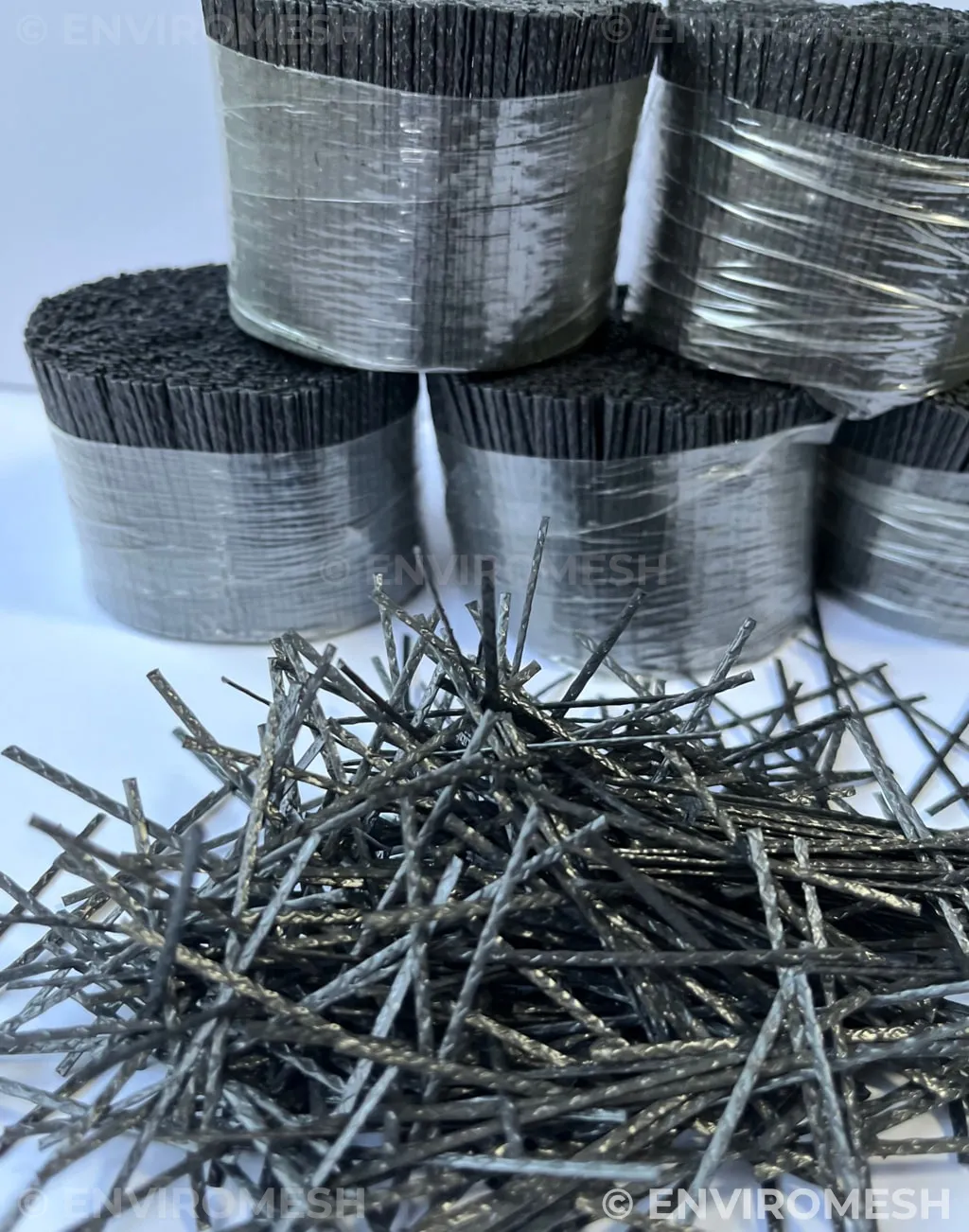
So in addition to the benefits of MSF reinforced concrete, eMesh promotes sustainability while delivering environmental and social benefits without adding cost to the construction and infrastructure projects.
The green credentials of eMesh have been tested by researchers, reporting up to 90% saving on CO2 emissions and reduced fossil fuel usage compared to traditional steel mesh reinforcing. The scientific findings behind the eMesh claims have been peer-reviewed by the prestigious Journal of Cleaner Production. eMesh has a third-party audited Environmental Product Declaration (EPD).
When using eMesh, councils can claim green ratings and private companies can boost carbon ratings, without additional costs. The environmental assessment conducted as part a PhD study confirmed the environmental benefits of using eMesh over SL72 mesh, such as savings on CO2 emissions.
Macro synthetic fibres can be used in a wide range of applications. Typically, these fibres are used in:
Prevent early-age cracking and enhance long-term crack resistance.
Enhance flexibility and toughness, extending service life under variable loads.
Improve durability and reduce surface cracking from temperature and load fluctuations.
Boost fatigue resistance and reduce crack propagation under traffic loads.
Limit maintenance by controlling shrinkage and cracking.
Improve dimensional stability and minimise cracking during handling and installation.
Control cracking from shrinkage and temperature changes while enhancing surface durability.
Strengthen concrete to withstand impact and weathering with reduced cracking.
Increase tensile strength and reduce permeability by limiting micro and macro cracking.
Enviromesh eMesh fibres recently featured in Australian Department of Agriculture, Water and Environment’s series of videos published to promote use of recycled content in construction and infrastructure projects.

Construction has traditionally worked a little like a one-way conveyor belt, with raw materials coming in at one end, buildings and infrastructure coming out the

The drawings are complete, the design team has issued the reinforcement schedule and procurement asks whether steel mesh can be replaced with a fibre solution.

For decades, steel mesh has been the default reinforcement solution for concrete construction. It is familiar, widely available and well understood. But the pressures shaping

Australia’s construction industry contributes approximately 7% of the nation’s GDP, playing a major role in infrastructure growth, employment and economic development. At the same time,

Concrete plays a critical role across civil infrastructure, from pavements and pathways to precast elements and drainage systems. In these applications, decisions around materials and

Concrete appears across roads, bridges, pavements, and precast structures but, despite its ubiquity, one critical choice in every project is often made by default: steel
Please submit the information below to request the document.